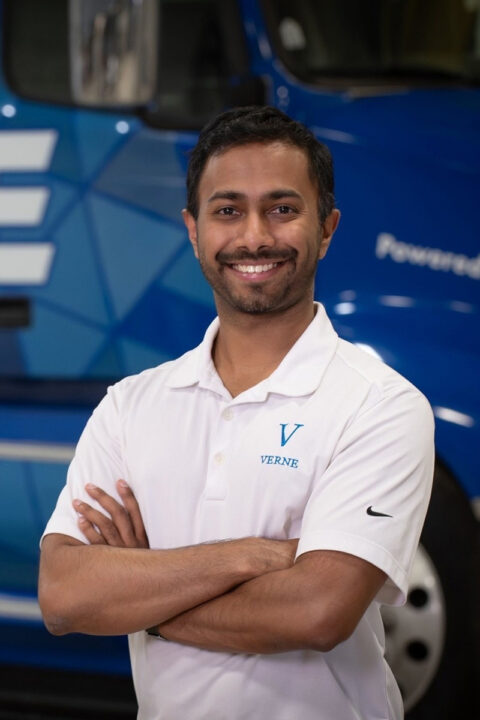
Bav Roy

Co-founder & COO,

Bav Roy is co-founder and COO at Verne, where he leads commercialization and strategy from San Francisco, CA. Prior to Verne, Bav started his career as a power engineer and project manager for commercial-scale solar power plants, before working on large scale gas, grid, and power generation projects while at the Boston Consulting Group. Bav studied at the Stanford Graduate School of Business (MBA) and UNSW (Renewable Energy Engineering). Bav has been named to the Forbes 30 Under 30 (Energy) and The Independent’s Climate 100 list, and was an inaugural Breakthrough Energy Fellow.
PTC: What technology breakthrough would pave the way for the ICT industry?
BR: The technology breakthrough that would pave the way for the ICT industry is reliable, scalable behind-the-meter power generation that can energize data centers ahead of the grid. Data centers are facing large energy demands driven by AI workloads, yet grid interconnection queues now stretch three to five years, or longer.
The breakthrough lies in modular, on-site power solutions that can deploy the best available technology for a given site, whether that’s natural gas today or nuclear tomorrow. We need a repeatable architecture to streamline the phased deployment of these power plants across the nation.
Every hyperscale data center or edge computing node depends on reliable, affordable power that can come online to meet the rapid growth in the industry. This breakthrough would unlock the ICT industry’s growth potential by decoupling digital infrastructure deployment from ever-lengthening grid timelines.
PTC: If one thing should be redeveloped within the telecom and related industries, what should it be?
BR: For decades, the industry has relied on a centralized grid model that cannot scale fast enough for modern compute demands. Data centers must gain power independence while maintaining the quality of service they received from the grid. This entails redeveloping how we think about on-site power as integrated microgrids that combine natural gas, battery storage, and eventually cleaner modular configurations, like nuclear and CCS.
The misconception persists that on-site power is too expensive and unreliable compared to grid power. In reality, modern behind-the-meter systems deliver uptime and avoid interconnection delays and transmission losses. The industry must address the misconceptions around microgrids. They are the necessary solution for mission-critical digital infrastructure this decade.
PTC: Is it important for companies to continue to innovate their organization or offerings, and why?
BR: In today’s energy landscape, innovation is essential. The AI revolution is reshaping power demands month-on-month, with data center energy consumption expected to double by 2030. Power forecasts, chip designs, and cooling methods are changing rapidly. Companies that aren’t innovating at-pace will be left with solutions for yesterday’s problem.
We take this seriously at Verne. Our modular approach creates a platform for continuous innovation, allowing us to introduce technologies such as power-cooling integration and zero-emission solutions in low-risk, bite-sized chunks over time.
PTC: What value does PTC hold for you/your company?
BR: PTC represents what is essential for success in infrastructure development: relationships and partnerships across the entire value chain. Verne’s approach is shaped around deep, long-term relationships with a trusted team: capital partners, hyperscalers, EPCs, equipment OEMs, and service providers.
As the ICT industry faces challenges with exponential demand growth, energy constraints, and sustainability imperatives, PTC provides the platform where these strategic partnerships form and knowledge exchange around microgrid deployment and other solutions occurs.
PTC: How does PTC fit your company’s goals or career purpose?
BR: PTC aligns with Verne’s goal of powering the new industrial base by rapidly deploying clean energy infrastructure. Our near-term goal is to support the current power crunch by deploying modular behind-the-meter gas power plants at ever-faster speeds. Relationships formed at PTC will help us divert our focus to the most time-critical needs in the industry; while ensuring we continue to strengthen our bench of partners that we bring to a given power project. For our team, participating in PTC directly advances our purpose of building out the next wave of energy infrastructure.
PTC: What advice would you share with current and future graduates interested in this field?
BR: There has never been a better time to enter the data center field and related fields like construction and power. The scale and pace of growth is staggering, which presents great opportunities to work on career-defining projects within the first few years of one’s career. Trust in this field is a hard one and easily lost, so focus on building trust within your network. If you do the basic things well in this field, you will have a stellar career with rich experiences, relationships, and growth.
PTC: What is something that not that many people know about you?
BR: I used to be a field technician in the Australian solar industry. Having done plant maintenance in the sweltering Australian summer (where my safety boots would melt), I have a lot of admiration for the boots-on-the ground personnel that keep our industry’s data centers and power plants online, all the time.
About Verne
Verne is a developer-operator of behind-the-meter power plants for large mission-critical loads, primarily data centers. Verne’s portfolio of on-site solutions available include natural gas and solar PV today, and firm clean power in the future. Verne is headquartered in Silicon Valley, California, with operations across North America. Verne’s investors include Amazon, Caterpillar, NextEra Energy, and United Airlines.
More profiles

Susan Anderton
Susan Anderton
Bav Roy
Bav Roy
Wilson Burns
Wilson Burns
Vince Sciarra
Vince Sciarra

Can Zhao