
There is perhaps no topic of greater interest — and less real comprehension — than artificial intelligence. Perhaps it’s because after decades of limited progress, in the last few years, computational power, algorithms, funding, storage capabilities for large datasets, and free open-source software have all come together to enable rapid progress.
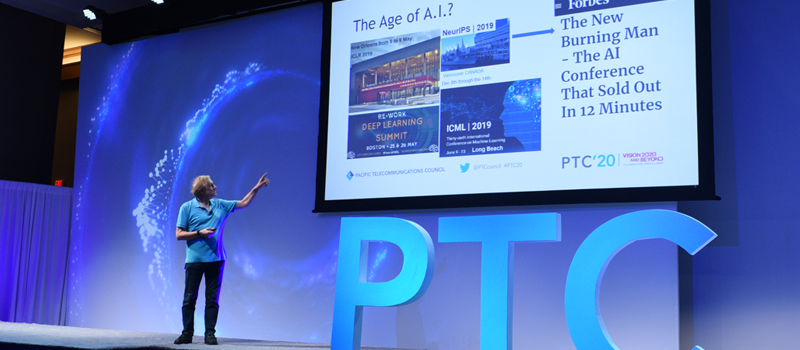
At the PTC’20 Annual Conference in January, I had the pleasure of introducing Dr. Piero Scaruffi, founder and president of the Silicon Valley Artificial Intelligence Research Institute, for his Center Stage Session. In his presentation, which has become one of PTC’20’s most viewed videos, he provides a quick overview of the state of AI, addressing in easily understandable fashion the technologies that have become part of the fabric of modern society, especially our social, mobile, Internet of Things world.
These include technologies for facial recognition in your social media app, language translation via your browser, speech recognition through your smart speaker, game playing on your phone or console, and so forth.
Perhaps the most magical technology that he reviews is called “Generative Adversarial Networks.” This enables machines to take a picture that includes zebras and convert it to one with horses, or vice versa. Or, to take a picture of mountains and trees in winter and reimagine it in summer. Even more impressive, it can turn a simple doodle of a waterfall sketched in only seconds into a photorealistic image of a mountain waterfall cascading among trees, rocks, and shadows.
As impressive as these leading-edge capabilities are, there are still numerous challenges to be overcome in AI in general and deep learning in particular. For example, the latest algorithms can correctly caption a photo as “a group of young people playing a game of frisbee [sic],” even though the disc is virtually invisible.
However, the technology is far from perfect. The same algorithm identified a traffic sign with stickers on it as “a refrigerator filled with lots of food and drinks.” As he says, that’s not just a mistake, but a “stupid mistake.” In other words, a human might miss the Frisbee in the scene and merely say that it was people playing in a field, but would never misconstrue a traffic sign for a refrigerator.
Part of the problem may be that machines don’t currently learn the way that humans do. “You have to show [a deep learning system] a million images of a banana before the machine can recognize the banana … you show a banana once to a child and it will know what a banana looks like.” This is why for now, self-driving cars are sometimes more like “self-crashing” cars.
The bottom line: AI is already achieving impressive results in all spheres of our society, and yet we are still in the extremely early days. Let’s admit it — you don’t know as much about AI — or its business applications — as you’d like. Why not free up 20 minutes and get caught up?
Check out related news
Message from Succession Planning Committee Chair

iMiller Public Relations Marks 15 Years Advancing Digital Infrastructure Communications and Community Engagement

ZincFive Expands Nickel-Zinc Technology into In-Rack Backup and AI Dynamic Power Solutions

OceanBit Feature in Submarine Telecoms Forum Issue 150