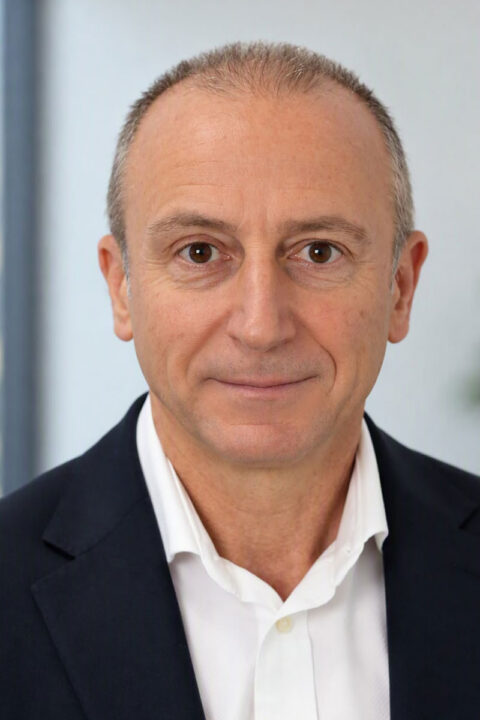
Gaspare Maria

Co-Founder and CEO
Gaspare Maria is co-Founder and CEO of Xacria, bringing 30 years of experience in the telecommunications industry, with a strong focus on OSS transformation, service orchestration and network automation.
Throughout his career, he has worked closely with Communication Service Providers (CSPs) on the evolution of complex, multi-vendor OSS environments, combining deep telecom domain expertise with a pragmatic approach to technology innovation. Today, he leads Xacria’s strategy and vision for autonomous networks, helping CSPs evolve from traditional automation towards increasingly autonomous, intent-driven and closed-loop operations. Under his leadership, Xacria has developed its OSS Suite (XSUITE) as a modular foundation for the progressive transformation of network operations, designed to integrate with existing network and OSS/BSS environments rather than requiring disruptive replacement. His focus is on turning the vision of autonomous networks into a practical and evolutionary journey for CSPs, combining innovation with openness, interoperability and the protection of existing technology investments.
What technology breakthrough would pave the way for the ICT industry?
GM: I believe the next breakthrough will be the transition from automated networks to truly autonomous networks.
AI alone will not make networks autonomous. The real breakthrough will come from combining AI with trusted network context, intent-based operations, real-time data and closed-loop automation, enabling networks not only to detect what is happening, but to understand what should happen and act accordingly.
For CSPs, this represents a fundamental shift: from managing thousands of individual network operations to defining business and service intent while increasingly delegating execution, optimization and remediation to the network itself.
How can corporations and researchers best serve the next generation?
GM: Corporations and researchers can best serve the next generation by bridging the gap between education, research and the real-world challenges faced by industry.
Technology is evolving faster than traditional education models can adapt. This makes collaboration between companies, universities, and research institutions increasingly important. The next generation should have opportunities to work on real problems, experiment with emerging technologies, and understand not only how technology works, but also how it can create meaningful value for businesses and society.
At the same time, we have a responsibility to promote open standards, knowledge sharing and responsible innovation, ensuring that advances in areas such as AI, automation and digital infrastructure remain sustainable, interoperable and accessible.
Ultimately, our role is not simply to prepare the next generation to use today’s technologies, but to give them the knowledge, experience and freedom to challenge them and build what comes next.
If one thing should be redeveloped within the telecom and related industries, what should it be?
GM: If I could redevelop one thing, it would be the way telecom networks are operated.
Over decades, operators have built increasingly powerful networks, but also highly complex operational environments, often fragmented across technologies, vendors, domains, and generations of OSS platforms. As networks continue to evolve, adding more systems and more automation is no longer enough.
I believe industry needs to move from managing networks through individual systems and workflows to managing them through intent and desired business outcomes. This requires a progressive transformation of the OSS environment, where orchestration, automation, assurance and AI work together across domains, with humans increasingly defining what the network should achieve rather than how every individual action should be executed.
This evolution cannot happen through disruptive replacement of everything that already exists. It must be progressive, open and interoperable, and protecting existing investments while creating the foundation for increasingly autonomous operations.
Ultimately, the opportunity is not simply to build better OSS, but to fundamentally simplify how increasingly complex networks are operated.
What value does PTC hold for you/your company?
GM: PTC provides a unique environment where technology, business, and global connectivity come together at an executive level.
For me and for Xacria, its greatest value is the opportunity to engage directly with leaders from across the global ICT ecosystem, exchange perspectives on how the industry is evolving, and build relationships that can develop into meaningful long-term partnerships.
As telecom networks and digital infrastructure become increasingly interconnected, innovation can no longer happen in isolation. Operators, technology providers, cloud companies, and infrastructure players need to collaborate more closely, combining different perspectives and capabilities to address increasingly complex challenges.
PTC creates the right environment for these conversations. It gives Xacria the opportunity not only to share our vision for the evolution towards autonomous networks, but also to listen, learn and understand the priorities shaping the next generation of global telecommunications.
For us, PTC is ultimately about connecting ideas, people, and opportunities that can turn technology innovation into real industry transformation.
What would you share with those interested in becoming a PTC Member?
GM: My advice would be simple: join with the intention to contribute, not just to participate.
The value of a community like PTC does not come simply from attending events or expanding your network. It comes from bringing your own experience to the conversation, being open to different perspectives, and being willing to share ideas and lessons learned.
Every company and every executive brings a different piece of the ICT ecosystem. When those experiences are shared openly, the community becomes a place where new ideas, collaborations, and opportunities can emerge naturally.
The more you contribute to the community, the more valuable it becomes, both for you and for everyone else.
What advice would you share with current and future graduates interested in this field?
GM: I have always been passionate about technology, and over the past 30 years I have seen it evolve at an extraordinary pace. If there is one lesson I would share with young graduates, it is this: build strong foundations.
Technologies will continuously change. What seems essential today may be replaced tomorrow. But a solid understanding of computer science, engineering principles and how systems work gives you the ability to understand change, adapt quickly and take advantage of new technologies rather than constantly having to catch up with them.
The second piece of advice is to stay curious and never take technology for granted. Ask how things work, question assumptions, experiment, and keep learning throughout your career.
This is even more important in the age of AI. Young professionals should not become passive consumers of artificial intelligence. They should develop the knowledge and critical thinking required to understand it, challenge its outputs and remain in control of how it is used.
Technology will keep changing. Strong foundations and curiosity are what allow you to change with it.
What is something that not that many people know about you?
GM: Something not many people know about me is my deep passion for the sea, particularly the underwater world.
Since I was young, I have practiced several challenging water sports, and for the past 10 years I have been practicing competitive freediving, both in the pool and in the open sea. I am particularly fascinated by depth and by the unique combination of physical preparation, mental discipline, and self-control that freediving requires.
Freediving teaches you to remain calm, understand your limits, and manage yourself under pressure. I find these lessons surprisingly valuable in everyday life, especially when you carry significant responsibilities and need to make decisions in challenging situations.
There is something that has always fascinated me about exploring your limits, learning to control yourself at the edge of them, and then gradually pushing those limits further.
What has been a positive outcome organizationally or individually given the current state of the world?
GM: One positive outcome of the rapid changes we are experiencing is a much stronger appreciation for adaptability.
For many years, organizations were built around the assumption that change could be planned, managed, and implemented over relatively long cycles. Today, technology, markets and global conditions can evolve much faster, forcing companies and leaders to continuously reassess priorities and make decisions with greater speed and flexibility.
I believe this has encouraged organizations to become more open to change, more willing to challenge established models and more comfortable with continuous transformation. It has also reinforced the importance of empowering people, because resilient organizations cannot depend on every decision being made from the top.
On an individual level, it reminds us that experience remains extremely valuable, but only when combined with curiosity and the willingness to keep learning.
Perhaps the most important lesson is that we cannot always predict the next change, but we can build organizations and mindsets that are ready for it.
About Xacria
Xacria is a telecommunications software company helping Communication Service Providers transform complex, multi-vendor networks into increasingly autonomous, software-driven environments.
Its Xacria OSS Suite (XSUITE) provides a modular foundation for OSS transformation, bringing together end-to-end service orchestration, multi-domain network automation, closed-loop assurance and intent management within a unified architecture.
Designed for complex telecom environments, XSUITE enables CSPs to progressively evolve their network operations towards intent-driven, closed-loop Autonomous Networks, while protecting existing investments and seamlessly integrating with established OSS/BSS ecosystems.
Built on cloud-native, event-driven principles and aligned with the TM Forum Open Digital Architecture (ODA) and Open APIs, XSUITE provides the openness, interoperability and scalability required by modern telecom operations.
Xacria’s technology is deployed by leading Communication Service Providers across multiple network domains, supporting mission-critical service and network automation use cases.
Hitachi Energy is a global leader in electrification, powering the electricity era to meet the energy demands of today and the next 25 years. As the energy arm of Hitachi Group, our technologies support over three billion people worldwide. With over a century of innovation, we are driving the evolution of the energy system to ensure abundant, secure, and affordable power. Established in over 140 countries, we are the grid ecosystem partner across the utility, industry, data center, and transportation sectors. Headquartered in Switzerland, we employ over 56,000 people in 60 countries and generate around $20 billion USD in revenue.
More profiles
Alex Hernandez
Alex Hernandez
Gaspare Maria
Gaspare Maria

Mike Onystok
Mike Onystok
Trent Sendre
Trent Sendre
Todd Raymond